Yanming Li, PhD
Faculty Scientist I
Center for Molecular Medicine
Li Lab
Understanding how genetic and epigenetic interactions shape cardiovascular disease.
SNP-Driven Epigenetic Alterations in Aortic Aneurysm
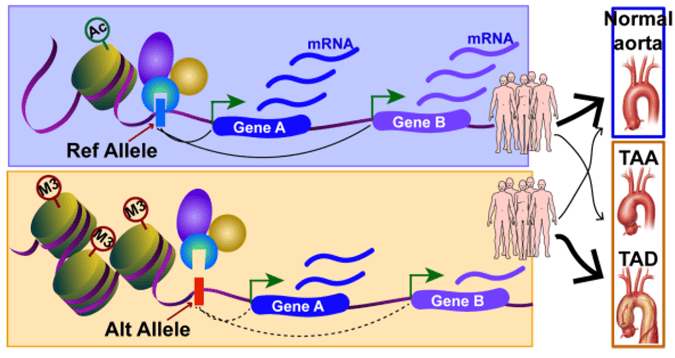
Thoracic aortic aneurysms and dissections (TAAD) are life-threatening conditions for which therapeutic options are limited. While genome-wide association studies (GWAS) have identified single nucleotide polymorphisms (SNPs) associated with sporadic TAAD, the molecular mechanisms through which these SNPs contribute to disease development remain unclear. Integrating GWAS data with single-cell chromatin accessibility (scATAC-seq) data from human aortic tissues has revealed that many TAAD-associated SNPs are located within accessible chromatin regions of aortic cells, suggesting that these SNPs influence regulatory elements activity. This project hypothesizes that the risk alleles of TAAD-associated SNPs alter transcription factors (TFs) binding affinities, reshaping the local epigenetic landscape and driving target gene dysregulation. By uncovering the functional and regulatory mechanisms of TAAD-associated SNPs, this study will provide critical insights into the genetic and epigenetic basis of aortic disease, potentially leading to new therapeutic strategies.
SMC Phenotypic Switching in Aortic Disease
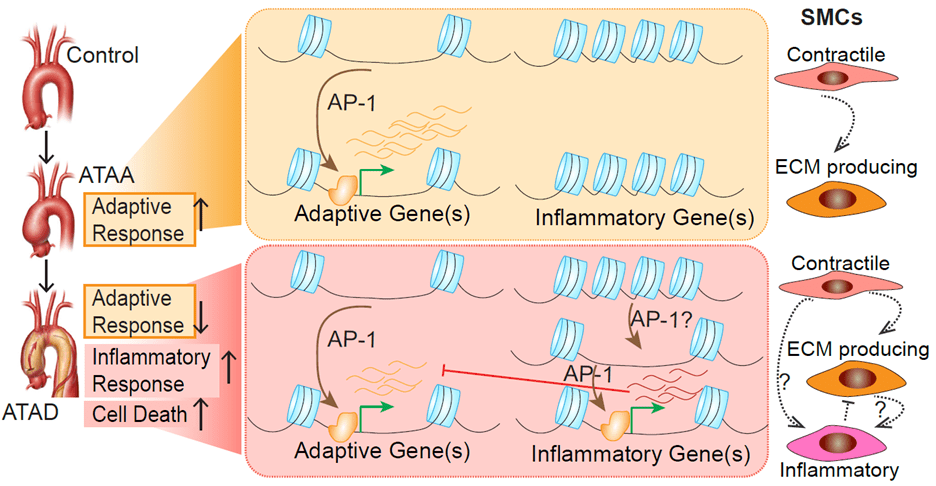
Our previous single-cell RNA sequencing (scRNA-seq) studies on human aortic tissues identified a disease-associated “phenotypic switch” in smooth muscle cells (SMCs). Specifically, we found that ECM-producing (adaptive) SMCs were higher in aneurysms, while inflammatory SMCs were higher in dissections, suggesting a progression from an adaptive to an inflammatory response. Our central hypothesis, supported by scATAC-seq data, is that the transcription factor AP-1 plays a dual role: it first promotes an adaptive response in aneurysms but then shifts to trigger an inflammatory response that leads to dissection. We propose three aims to test this hypothesis. Aim 1 will use single-cell ATAC-seq and spatial transcriptomics on human aortic tissues to map the dynamic regulatory networks of adaptive and inflammatory SMCs. Aim 2 will investigate AP-1’s role in the adaptive response using stressed human primary SMCs and mouse aneurysm models, focusing on how it promotes ECM and proliferative gene expression. Aim 3 will investigate AP-1’s role in the inflammatory response using severely stressed human primary SMCs and mouse dissection models, focusing on how it elevates inflammatory gene expression. We expect to identify novel molecular mechanisms that control the adaptive-to-inflammatory switch, which will significantly enhance our understanding of ATAAD and potentially lead to new diagnostic markers and therapeutic strategies to prevent dissection and rupture.